
In October I spoke at the State of B2B GTM Summit. The session had a slightly provocative title: “B2B paid is bigger than LinkedIn now.” Here’s the argument, the data behind it, and what I’d do about it heading into 2027.
Same buyer, different moments
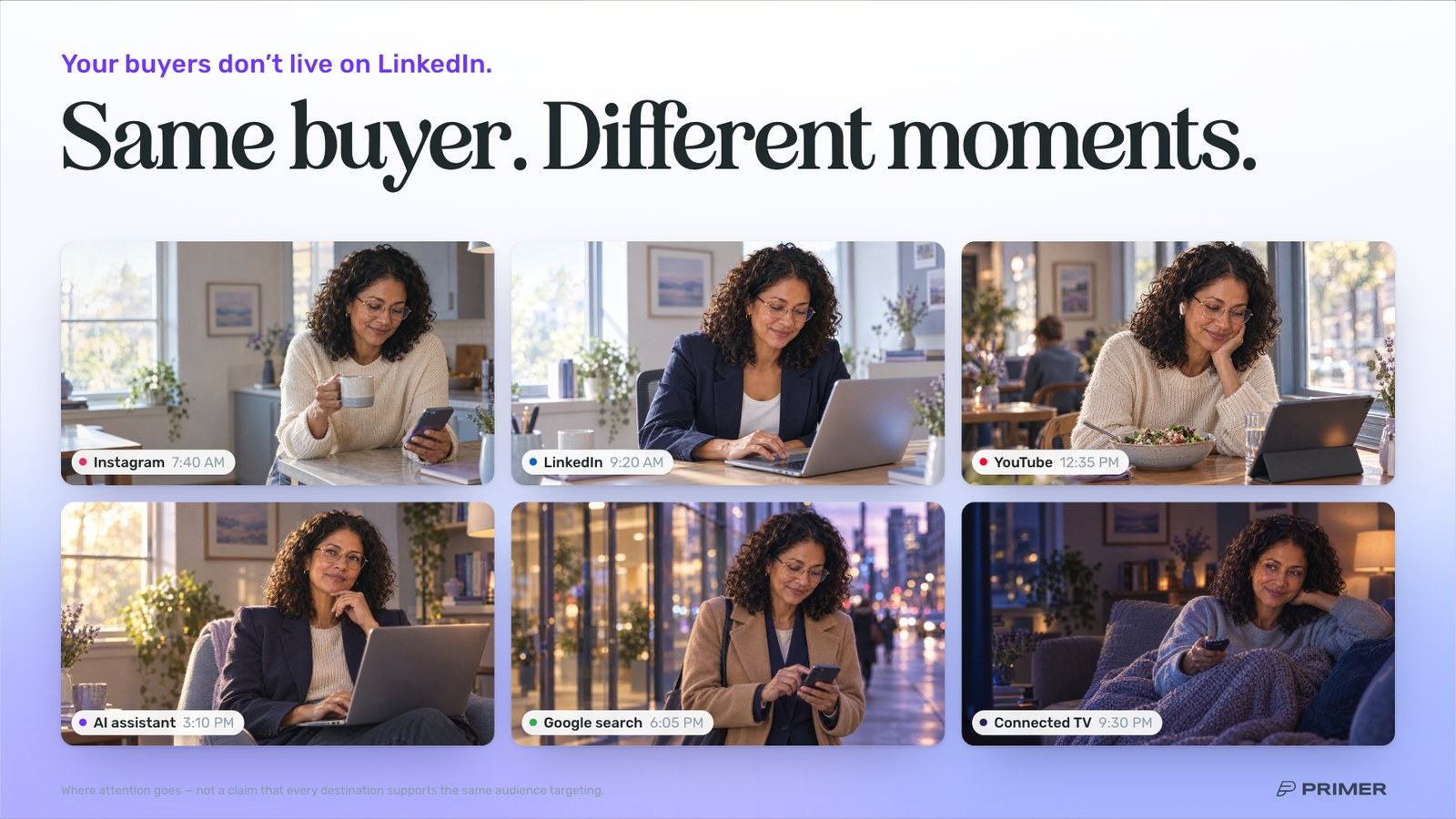
Think about one buyer’s day. She’s the CFO at a 500-person software company. She scrolls Instagram with her morning coffee, checks LinkedIn at her desk, watches YouTube over lunch, asks an AI assistant how other finance teams run month-end close, Googles a vendor someone mentioned on the walk home, and ends the day in front of the TV.
Your CFO doesn’t stop being a CFO when she opens Instagram.
That matters more in 2027 than it ever has, because the scarcest resource in marketing is attention. AI has made content close to free to produce, so the volume of ads is skyrocketing and demand for ad inventory keeps growing. The number of people doesn’t. Your buyers aren’t multiplying. So the most important question for 2027 is where and how you can reach your target market across all the places they actually spend their attention. That was always true. It’s just never mattered more.
What changed in B2B paid this year
For our State of B2B Paid Advertising 2026 report, we looked at 379 B2B advertisers across Google, LinkedIn and Meta over the 12 months through August 2026. Three shifts stood out:
- Meta became B2B’s second channel. The share of advertisers running Meta grew from 54% to 63%, and about 89% of Meta spend goes to lead and sales objectives. People aren’t buying vanity reach there; they’re asking Meta for pipeline.
- Media costs are mostly rising. PLG advertisers saw their median LinkedIn CPM rise 43%.
- Google conversions got pricier. Google’s platform-reported cost per conversion rose about 27%, while the median cost per click rose about 11%.
Running ads on a channel is one thing. Where people actually allocate their budget is another. Among advertisers we could observe in both windows, Meta’s average share of budget went from 20.8% in December–February to 24.9% in June–August. Google’s went from 43.6% to 40.9%. LinkedIn was roughly flat.
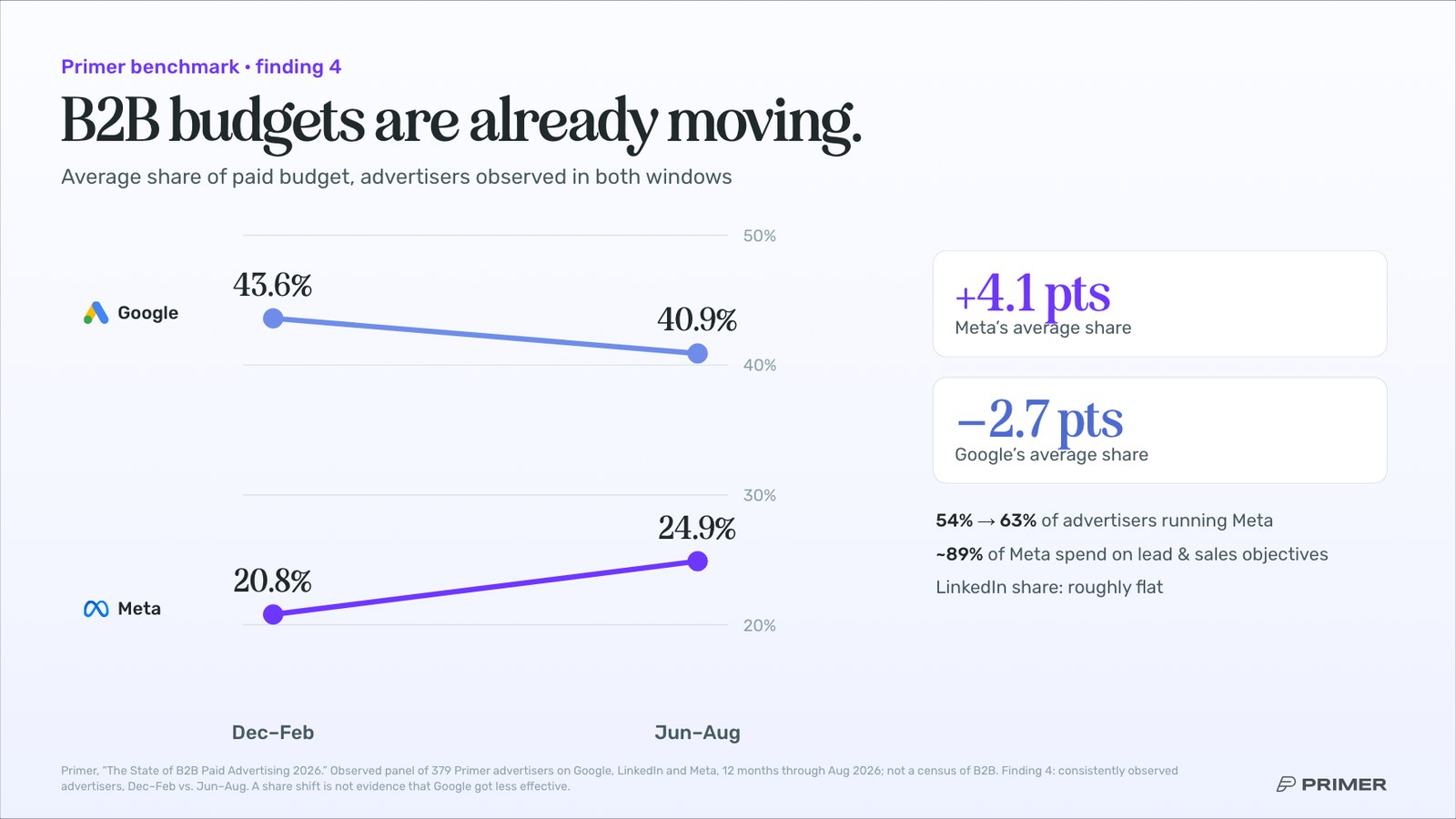
What that tells me: marketers are chasing the channels where they think the next dollar returns more. Meta is on the rise, and Google, at least in share of budget, is on the decline.
LinkedIn’s premium is real, and it’s rising
When we compare the same advertiser on both platforms, a thousand LinkedIn impressions typically cost 5.3 times what they cost on Meta. Put another way, the price of a thousand LinkedIn impressions buys about fifty-three hundred on Meta.
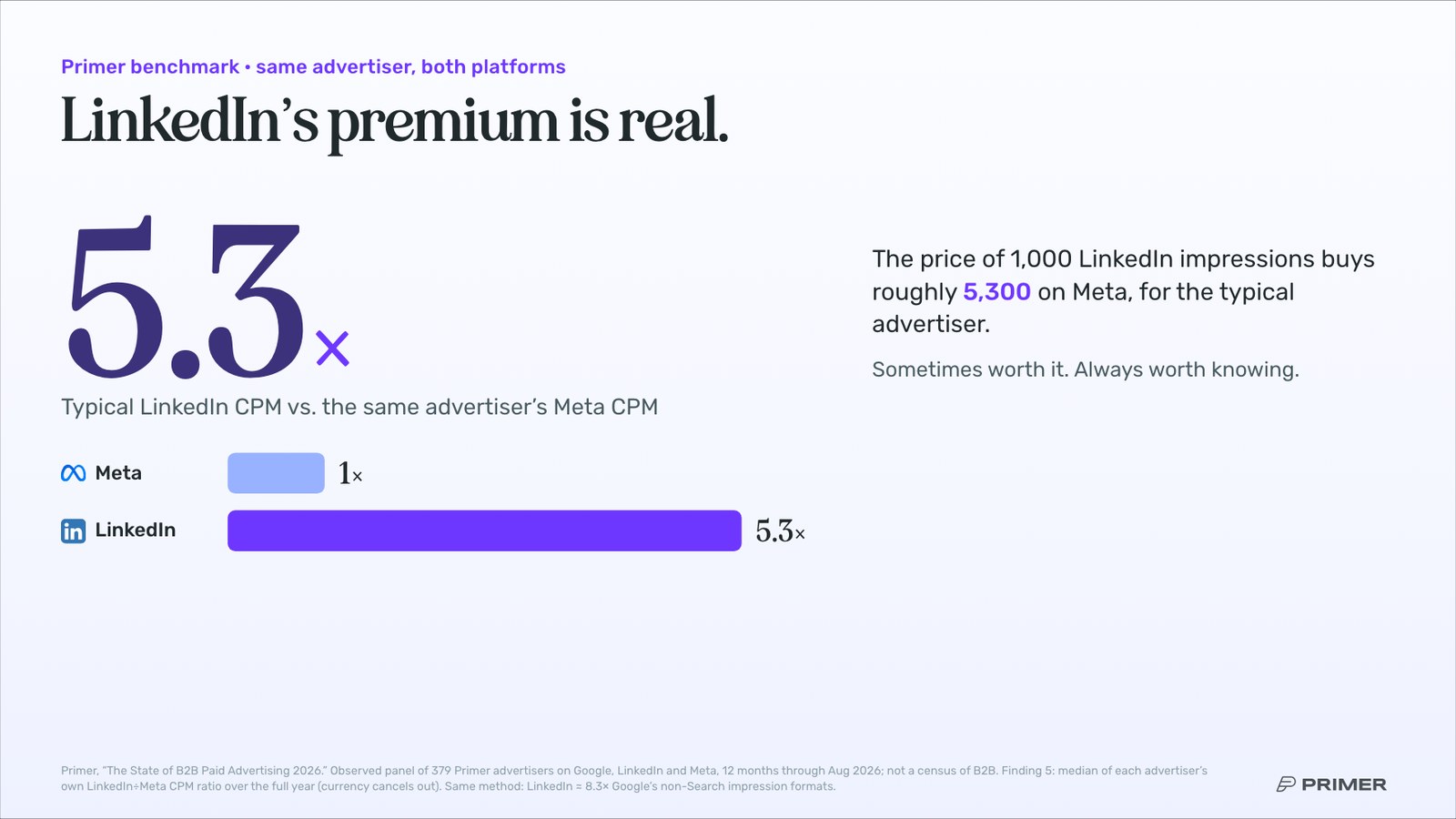
And before you say, “Of course, you’re paying for LinkedIn’s ability to target professionals”: that’s true. LinkedIn may not be overpriced. But here’s my read on why budget is shifting to Meta anyway. The smartest marketers are finding ways to bring that professional-level targeting into Meta, so they get the lower cost while keeping the quality.
It’s not just the relative cost between channels, either. Prices are climbing fast. For PLG companies, the median LinkedIn CPM grew 43% between December–February and June–August, and Meta’s rose 35%. Other GTM motions moved differently: ABM teams saw Google CPMs rise 20%, while Demand Gen teams saw LinkedIn CPMs dip 6% even as their LinkedIn cost per click rose 42%.
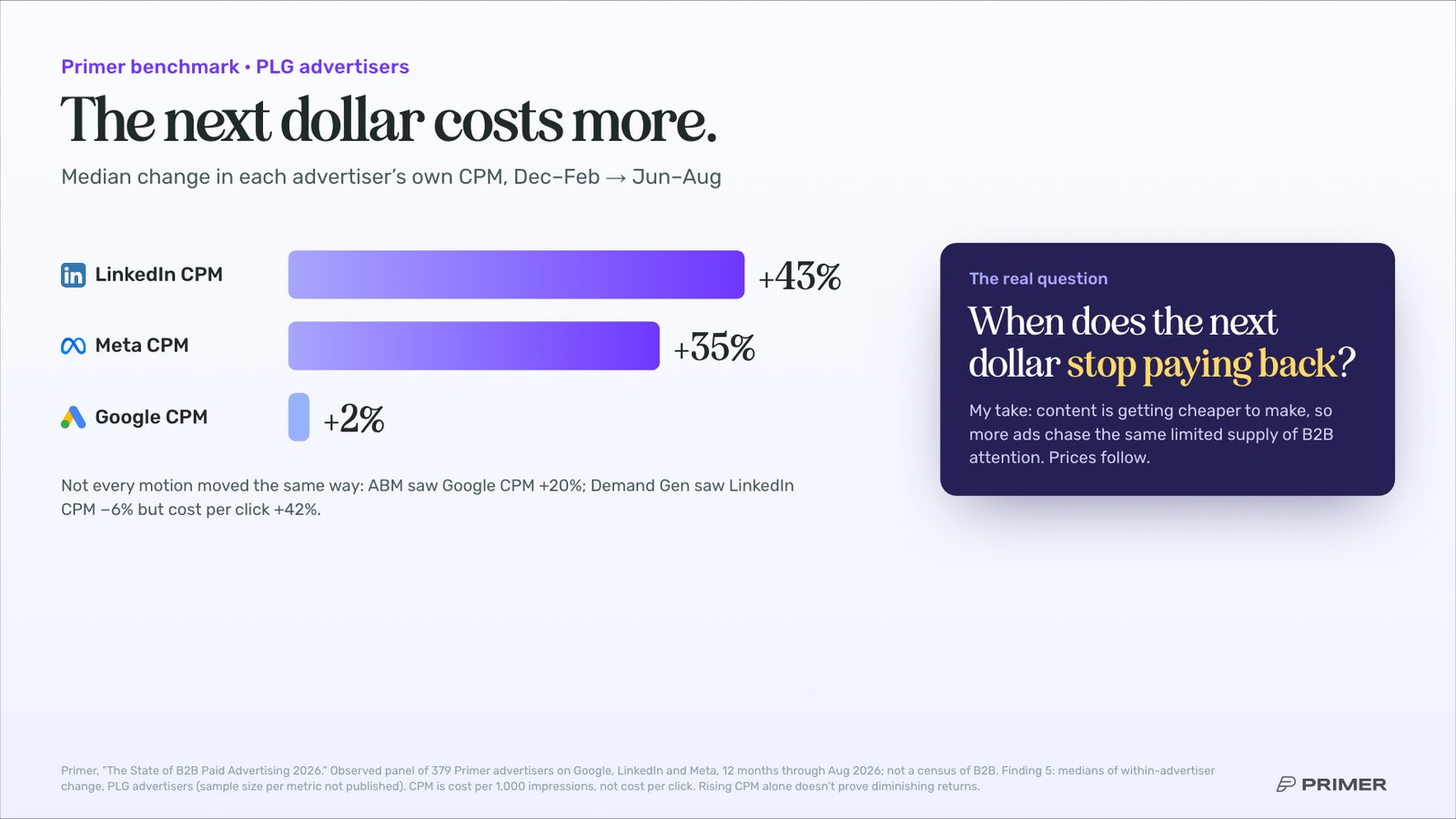
So the real question isn’t whether paid is getting more expensive. It’s this: if these rates continue, when does the next dollar stop paying back? My take on why that point is arriving sooner: content is cheaper to make, so more ads chase the same limited supply of B2B attention, and prices follow. If all your spend sits on one expensive channel, you hit that ceiling faster. In 2027, you have to be thinking about diversifying.
“B2B” is too broad a benchmark
One of the most interesting findings from the report: you can’t lump all B2B companies together and find one pattern. Companies are multidimensional.
At first we thought the smart way to slice the data was by who you sell to, comparing companies that sell to IT security with companies that sell to HR. But one of the strongest predictors turned out to be how you go to market: ABM, driving a smaller market to a demo, or PLG, driving a big market to a sign-up. ABM teams typically put 30% of their budget on LinkedIn; PLG teams, 12%.
Size matters too. 59% of companies doing $1–10M in revenue advertise on just one platform. Above $50M, it’s only about one in five, and when companies add a second platform, it’s most often Meta. And AI-native companies put far more on LinkedIn: 43% of their pooled spend, versus 13% for everyone else. That last group is small, so treat it as directional.
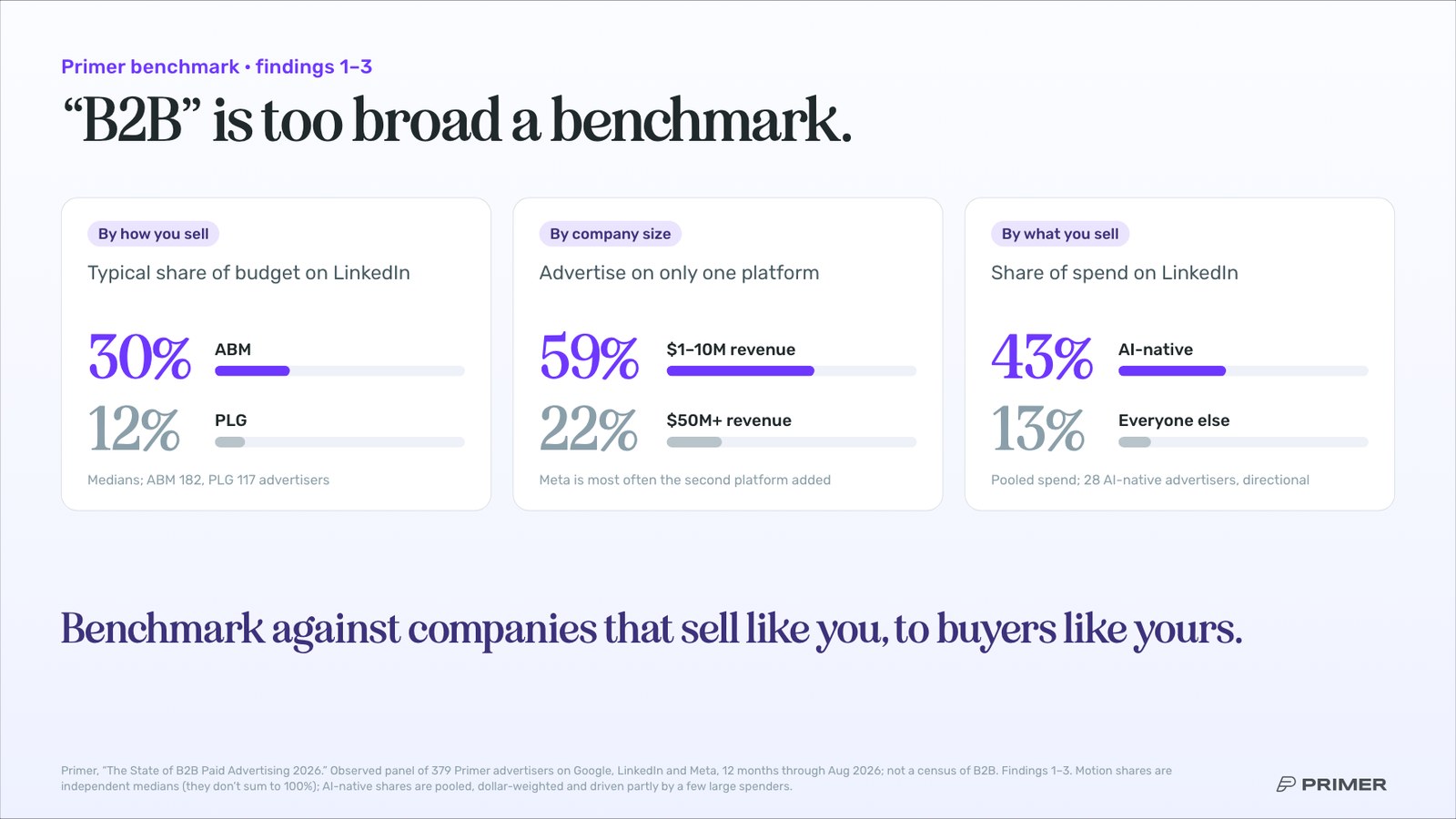
If you want benchmarks for companies like yours, explore the full report and its different slices.
Stop thinking channel-first
Here’s the shift I think picks up steam in 2027, because of those cost dynamics.
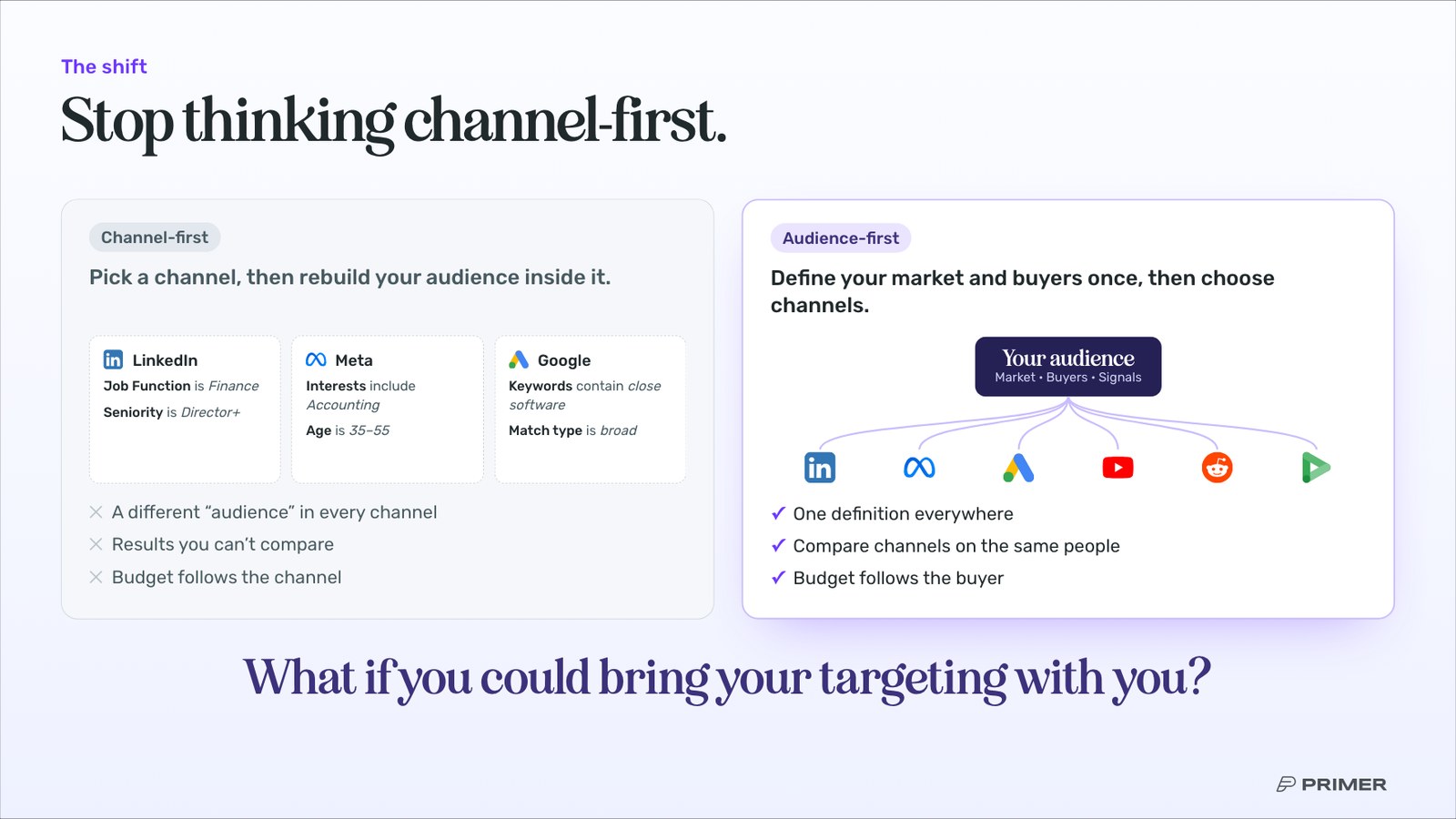
The classic way to run paid is channel-first. We pick LinkedIn because that’s where the buyers are, and build the audience inside LinkedIn’s filters. Then we go to search, pick keywords, and try to avoid the ones consumers search for. At some point we experiment with Meta, interests and demographics, and it probably doesn’t work. So the default becomes LinkedIn plus a limited set of Google keywords.
If there’s one pattern to break, it’s that. Flip it: think audience-first. Define your market and your buyers once, outside the channels. Layer in the signals that matter to you. Then decide where to reach them. Do that and you reach the same people everywhere, you can actually compare channels, and budget follows the buyer.
Bring your targeting with you
So how do you actually do it? One of the best things happening in data and GTM right now is that building your own TAM list is far easier, and far more precise, than it used to be. You’ve got Apollo, Clay and plenty of new entrants. Your market, your buyers and your signals become one audience definition.
Then you hit the real problem: match rates. Push a list of work emails into LinkedIn and you’ll typically match about half. Meta, about 20%. Google, YouTube and Reddit, about 2%. That’s a big reason B2B never left LinkedIn. It wasn’t the channels; it was the match.
The fix is identity enrichment: before you upload, add identifiers the platforms can match, like personal emails. You can do that with your own data team, or with tools like Primer, Clay Ads and others. Enriched, Meta match rates go to 65–85% and Google Search to 35–45%.
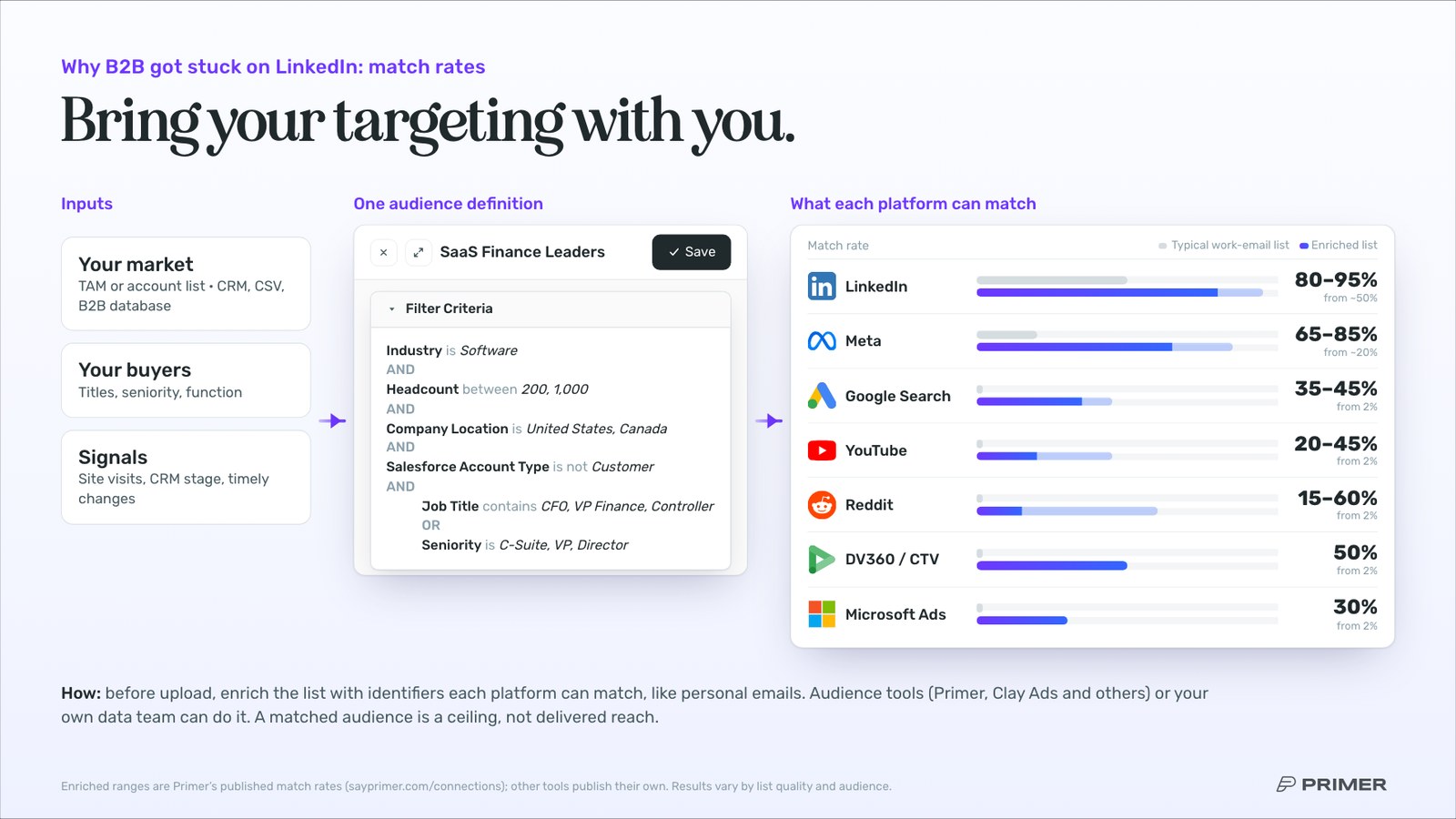
Two cautions. First, a matched audience is a ceiling, not delivered reach; what you can actually deliver still depends on bids, budget, placements, frequency and each campaign type’s audience rules. Second, your audience won’t be reachable everywhere. Coverage shifts by persona: a channel that reaches IT and security leaders well might barely reach procurement. Check the estimates for your own audience before you pick channels.
Give each channel a job
All of a sudden, when you have more channels in the mix, you can give each channel a job, or learn the job each channel is already doing.
Here’s how it works for us at Primer. We get a lot of discovery through YouTube Demand Gen ads and connected TV. Meta shows up fairly early in the journey too. Search captures brand queries. And LinkedIn converts on retargeting. If we judged every channel on last click, we’d cut the ones doing the early work.
So once you expand into multiple channels, evaluate the paths, and judge the system on qualified responses, then opportunities, then revenue. Your attribution approach alone can change the story: in our benchmark, switching from last-touch to any-touch moves LinkedIn’s credit about sevenfold.
AI makes more content. You still need a reason to care.
AI is going to make the noise problem worse before it makes marketing better. More content and more campaigns don’t automatically create more demand. They create more of the same.
As targeting and campaign operations get easier, which they will, the advantage moves to what’s still hard, and honestly the fun part of marketing: understanding your buyer, having a creative idea, and making something that stops someone from scrolling.
One recent example I love is Ramp’s “Tony Stock: Pro Trader”: Tony Hawk goes into witness protection on a 2006 Wall Street trading floor, told in short episodes that end on a cliffhanger, with a live finale announced for the New York Stock Exchange. It leans on a recognizable cultural reference, it’s an unexpected story you want to finish, and every episode is another moment to share and promote.
You don’t need a celebrity budget to do this. Lean into the zeitgeist and make content that stands out. And when something resonates, putting paid behind it amplifies it even more. Create moments that paid can amplify, and let targeting make sure the right buyers see them on every channel they’re already on.
Where to start
Some practical takeaways if you’re running paid:
- Audit what you run today. Where does the money go? Who does it actually reach? What turns into qualified pipeline?
- Fix the two biggest levers. Targeting (who sees it) and creative (why they’d care). Both are easier to improve than ever.
- Figure out where your ICP engages. Think ICP-first, not channel-first, and check where they’re reachable.
- Run a targeted experiment. Take your best LinkedIn audience, enrich it, and launch it on one new channel where it matches well, with creative built for that context. Hold back a comparison group so you can measure the incremental impact of advertising on that channel.
Know who you want to reach. Make something they’ll care about. Put paid behind it.
For the full data behind this post, read The State of B2B Paid Advertising 2026.