
A campaign is only as good as the data behind it. You can write the sharpest ad of the year, but if it reaches the wrong people, or can't find the right ones, it goes nowhere.
That's why we built Primer's database around a simple idea: fewer, better records beat a bigger pile of stale ones. Here's how it's structured, how we enrich it, how we keep it compliant, and where it works best.
Primer's database at a glance
| Companies | 18.9M+ |
| People | 299M+ |
| Best ad platform match rates | North America |
| Lowest ad platform match rates | APAC |
1. B2B and B2C data, together
Most data providers pick a lane: business data or consumer data. Primer's database is built on both, on purpose.
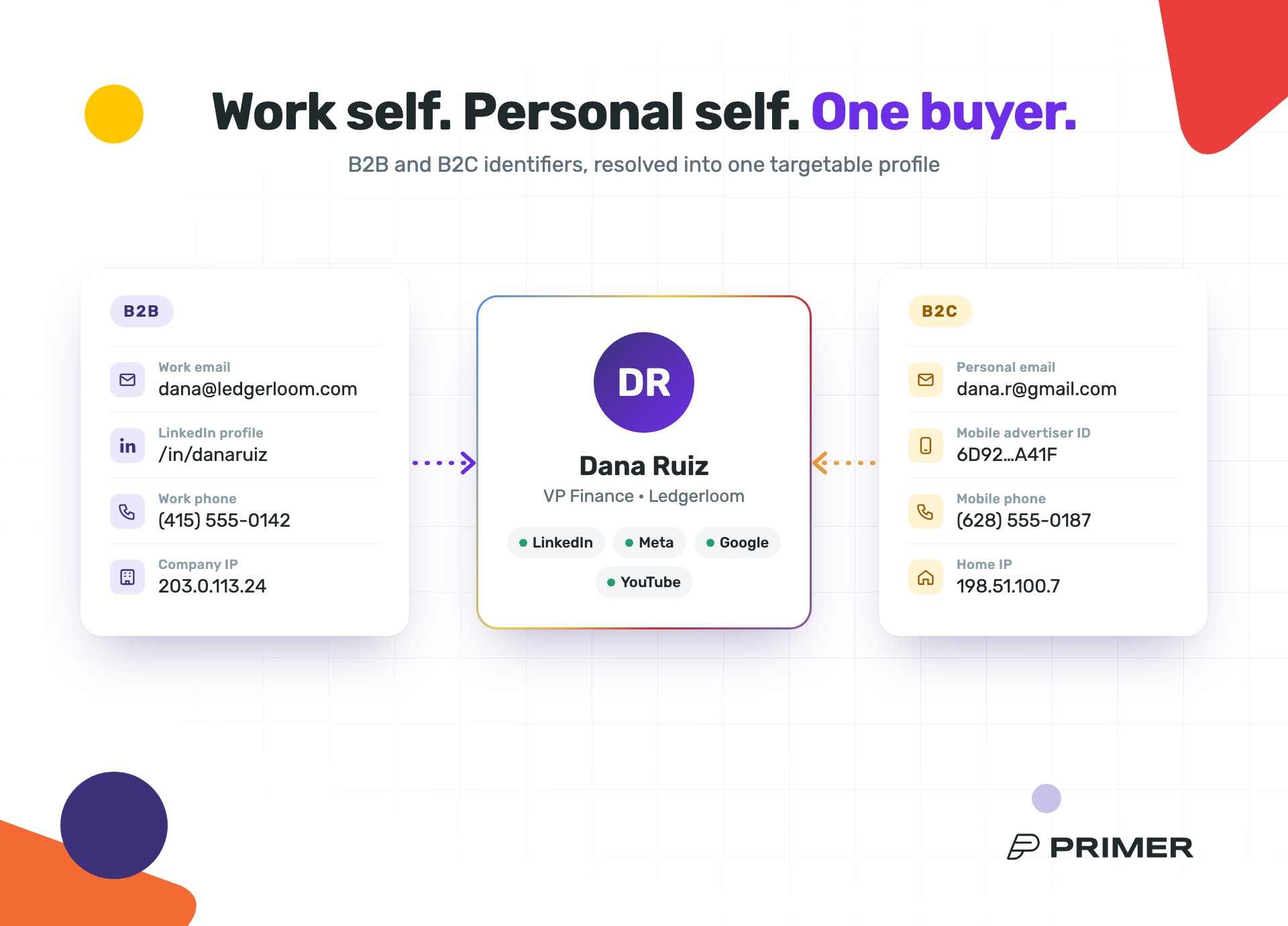
Here's why. Most decision-makers don't log into Facebook, LinkedIn or YouTube with their work email. They use a personal address, like Gmail or Yahoo. A B2B-only database never sees that side of a person, so it misses them exactly where your ads run.
By pairing B2B records with B2C data points, Primer gives you a fuller, more accurate picture of the people you actually want to reach, so targeting and personalization land.
| B2B identifiers | B2C identifiers |
|---|---|
| Work email | Personal email |
| LinkedIn profile URL | Mobile advertiser ID |
| Work phone | Mobile phone |
| Company IP address | Home IP address |
2. Opted-in data, built for compliance
We take data privacy seriously. Every record that comes into Primer's platform is sourced from opted-in partners, so the database is built to comply with GDPR, CCPA and other key privacy regulations.
To be transparent about how that works: we hold every incoming source to compliance best practices, and we rely on our data partners to maintain that standard. That partnership is what lets us offer broad coverage without compromising on privacy or regulatory adherence.
3. Quality over quantity
Many data providers race to make their database as big as possible. We do the opposite: we deliberately constrain what goes into the product so every record is relevant, accurate and actionable.
A huge volume of data is worth less than a focused set you can trust. Cutting the noise means your campaigns run on the records that matter, and your targeting stays precise.
Here's what that looks like in practice:
| Total records | Records in product | Quality guardrail | |
|---|---|---|---|
| People | 1 billion+ | 299M+ | Job status on LinkedIn verified within the last 270 days |
| Companies | 55M+ | 18.9M+ | At least 1 employee with a verified LinkedIn profile |
Like other providers, we also label and categorize records so filtering is easy. See our audience filters.
4. Identity resolution: matching the work self to the personal self
Primer's real strength is enriching B2B records with B2C data points. That's what boosts match rates and fills coverage gaps.
Take Google. Someone browsing there is usually signed in with a personal email, not their work one. If all you have is their work email, you can't match them. Primer closes that gap by layering B2C data onto B2B profiles.
Resolving those two identities gives you a much clearer view of your audience. Whether you're building ABM lists or running personalized ad campaigns, you get the depth you need to reach the right people.
5. Where it works best
Coverage is strongest in the U.S. and Canada, where privacy laws are more permissive. If North America is your main market, Primer delivers high match rates and broad coverage.
The European Union is harder. Stricter rules on privacy and consent mean far less opted-in data is available, so match rates and coverage for EU targeting are more limited. If the EU is your focus, expect reduced results today.
6. What's next: a provider waterfall
The future of data-driven marketing is layered. We're actively exploring a "waterfall" of multiple data providers: when one has thin coverage, as in the EU, the next fills the gap. The goal is simple: maximum coverage, and campaigns that perform wherever your buyers are.
That's the thinking behind Primer's database: B2B and B2C combined, opted-in sources, strict quality guardrails, and identity resolution that finds your buyers where they actually spend their time.