Most B2B teams have an ICP. Far fewer have actually validated which parts of it are working.
The uncomfortable truth in B2B marketing is that "ICP" is usually a story we tell ourselves, not something we've actually validated. We say "mid-market SaaS" or "VP Marketing at fintech companies." But within those categories, there are pockets that convert like crazy, and others that never will.
Most tools flatten all of that into clicks, conversions, and maybe a CAC number if you're lucky. So we end up optimizing campaigns without easily knowing who inside the ICP they are working for.
See which parts of the market are actually responding
An ICP is useful because it gives us a place to start. The problem comes when we treat it as one uniform audience. The companies inside it can look right on paper and still behave very differently once campaigns are live.
What we've built into Primer's Conversion Reports is a way to actually see that: which segments of the B2B world are attracted to the website and are converting. Instead of judging the entire ICP as good or bad, we can filter visits and form fills by industry, company size, revenue, department or seniority, and validate the assumptions behind the audience.
If one pocket of the ICP is responsible for a disproportionate amount of the response, that is useful information in its own right, and the same is true if another part repeatedly fails to respond. It can influence which audiences we test next and which parts of the ICP we focus on. Our guide to audience analysis and segmentation goes deeper on why that level of precision matters.
Which audiences are creating incremental lift
There is another layer beyond identifying the segments that convert. We also want to understand which audiences we're targeting are creating incremental lift, not just capturing demand.
A campaign can record conversions and still leave that question open: did targeting that audience create additional demand, or did it mostly capture buyers who were already likely to convert? An audience that is creating incremental lift gives us a stronger reason to keep investing in it than one that only looks good in standard attribution.
Getting pulled outside the ICP can be a bug or a feature
Sometimes we start seeing companies that do not fit the ICP we defined. The easy reaction is to treat all of that as waste, but the more useful question is whether getting pulled outside the ICP is a bug or a feature.
In some cases, it means we're being pulled away from the ICP we intended to reach. In others, it reveals a part of the market that was missing from the original ICP but is still showing interest or converting. Not every unexpected segment belongs in the ICP, but the behavior is worth understanding before we dismiss it.
For example, in one of our own reports, 69 of the 92 people who submitted a form were outside the audience we were targeting. The largest group among them was Marketing & Advertising companies, with 14 form submitters, and another 19 came from companies with 20 or fewer employees.
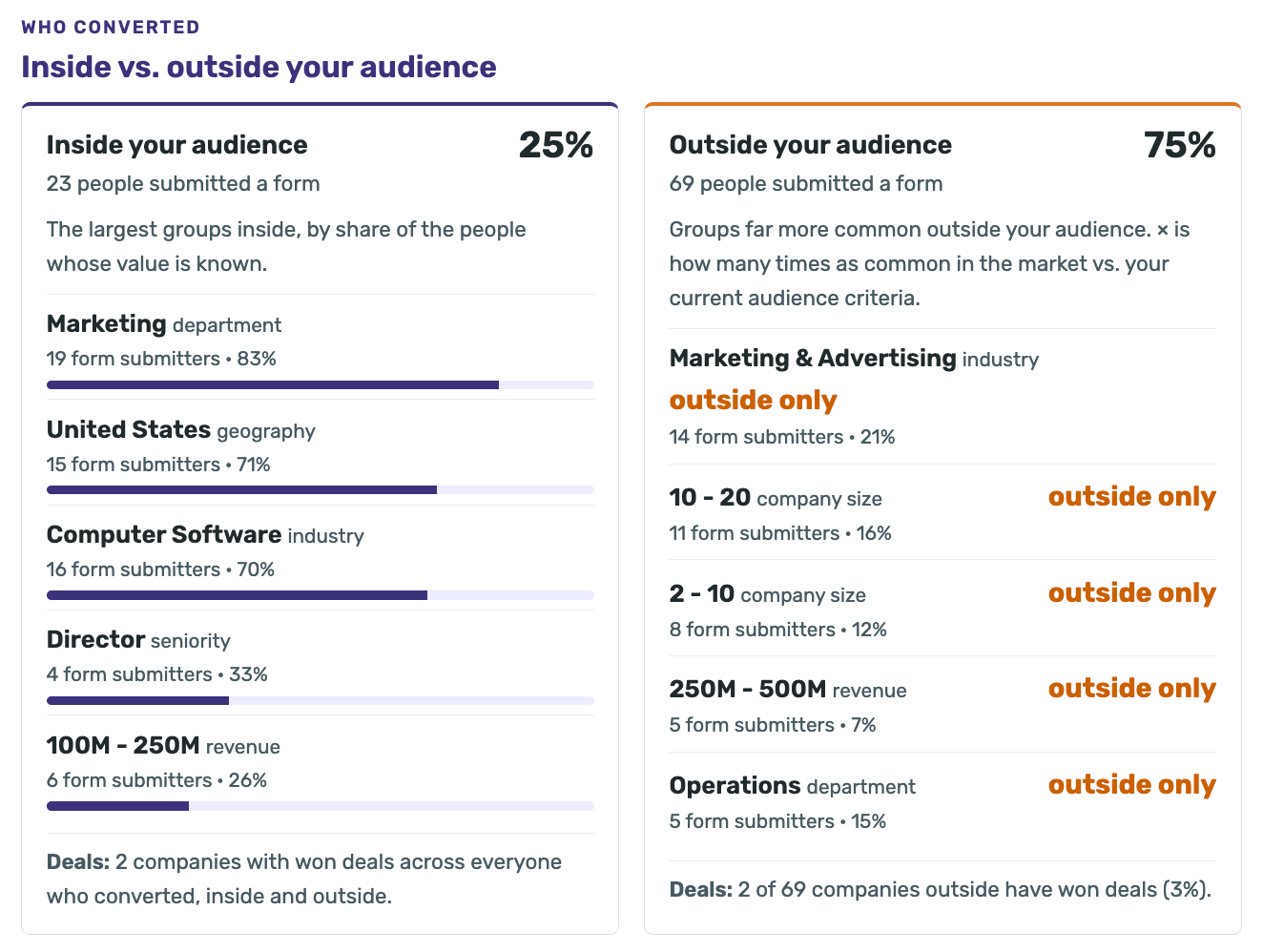
"Inside vs. outside your audience" in a Primer report: 75% of form submitters came from outside the targeted audience.
Stop thinking in channels and start thinking in clusters of buyers
A lot of campaign optimization happens one channel at a time. We review performance inside each platform, make adjustments and decide where the next round of budget should go.
Once we see our audience this way, campaign optimization changes. We stop thinking in channels and start thinking in clusters of buyers, and that's when things get interesting.
The next time you review a campaign, look past the channel-level result and ask which pockets of the market are responding. That is where the next audience test should come from.